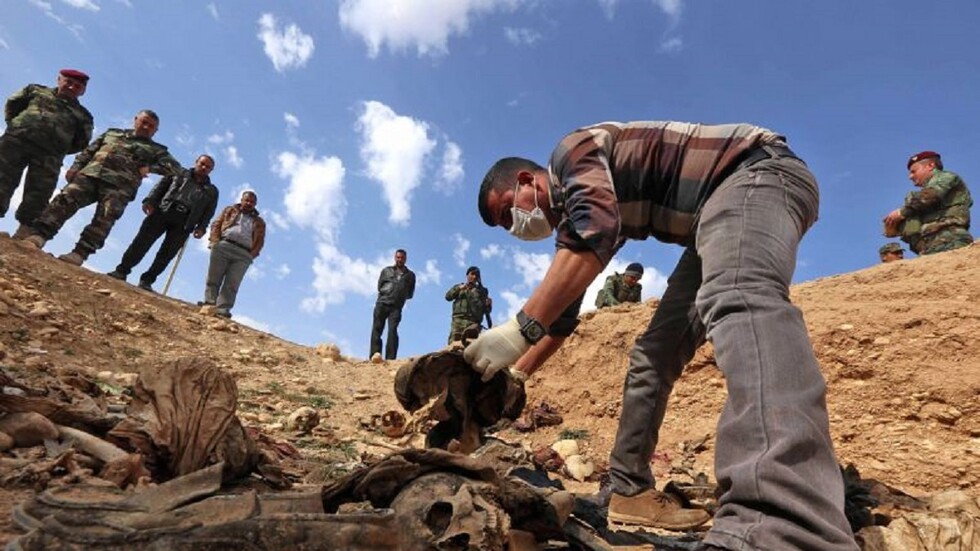
Jihan Saad remembers the night her husband and her brother became two more names on a list that, a decade later, still has no ending. It was 2016, in al-Bu Akkash, a small village in Iraq’s Anbar province, during the operation to retake the area from the Islamic State. Soldiers ordered families out of their homes after dark, separated the men from the women for what was called a security screening, and then simply did not give the men back. Jihan calls it “a series of terror.” An estimated 700 men vanished from al-Bu Akkash that single night — enough that the village is now known across Iraq by a different name: the village without men. The handful who did return came back with visible marks of torture and no information about anyone else. Everyone since has been left to construct their own theory of what happened. “Some people say they were killed, some say they were burned, some say they were blown up,” Jihan says. “Everyone tells you something different.” Every year, she says, a mass grave is opened somewhere in Anbar, and every year officials say it belongs to the missing of a different town — Saqlawiya, not al-Bu Akkash — before the claim is quietly walked back, reopening a wound that had barely closed. In 2020, four years into not knowing, Jihan gave up waiting for an answer and did the only thing the Iraqi state offered her: she registered her husband as dead, so that she could collect the government benefit that would let her feed the five children he left behind, the eldest of whom was twelve when his father disappeared.
Every August 30, the United Nations marks the International Day of the Victims of Enforced Disappearance, created to press governments for two specific things: the truth about what happened to the missing, and justice for the families still waiting on it. Iraq’s post-2003 record tests that mandate as thoroughly as any country’s, because the men who took Jihan Saad’s husband did not belong to a fallen dictatorship or a defeated terrorist group — they belonged to armed factions that are, on paper, part of the Iraqi state itself, operating in the open, year after year, under every government elected since the old regime fell. What happened at al-Bu Akkash is not an isolated horror. It is the most recent chapter in a continuous, twenty-year record of Shia militia factions disappearing Iraqis with almost total impunity, one that began within two years of the 2003 invasion and has never actually stopped.
The Interior Ministry’s Bunkers
The pattern started early, and it started inside the state. In November 2005, American and Iraqi forces raided a bunker beneath an Interior Ministry building in Baghdad’s Jadriya district and found 173 detainees, malnourished and, according to the Iraqi prime minister at the time, showing signs of torture; at least 18 more detainees had already died in custody there. One former detainee later said his Shia guards told him plainly: “Sunnis are out of power now and we have to take revenge.” The facility operated under an Interior Ministry then dominated by the Badr Organization, and it was linked to the ministry’s own paramilitary police commando units, among them the unit that became notorious as the Wolf Brigade. It was not the last such site to surface — a second secret facility at Baghdad’s old al-Muthanna airport was found years later holding 431 prisoners, more than 100 of whom described electric shocks, suffocation with plastic bags, and beatings, with at least one dying from the abuse.
Outside the ministry’s own basements, the death squads worked in the open. By the Iraqi government’s own count, killings in Baghdad in July and August of 2006 alone exceeded 5,000, the bulk of them sectarian executions carried out amid a civil war in which, as Human Rights Watch documented at the time, Shia armed groups — the Mahdi Army and the Badr militia by name — were reportedly responsible for large numbers of the abductions and killings of Sunni civilians, dumped afterward in the streets or in the Tigris. The violence displaced somewhere between 234,000 and 400,000 people, depending on whose count is used. Investigations into any of it, by the Iraqi government’s own admission at the time, produced almost nothing.
The Islamic State Era’s Second Wave
The same pattern resurfaced, largely unchanged, once Iraq’s Shia militias were absorbed into the Popular Mobilization Forces to fight the Islamic State after 2014 — an umbrella that gave the factions state salaries, state weapons, and a state legal personality, without ever subjecting them to a state’s accountability. Al-Bu Akkash sits inside a larger, well-documented case: Amnesty International has confirmed that 643 men and boys were abducted from the Saqlawiya area of Anbar on June 2 and 3, 2016, during the operation to retake Fallujah — families believe the true number is higher — and that Popular Mobilization Units were responsible. Then-Prime Minister Haider al-Abadi announced an investigative committee within days. Seven years later, in 2023, Amnesty was still waiting for its findings to be made public; Iraq’s Foreign Ministry response, when it finally came, contained no substantive information at all. One witness account collected during the investigation described Popular Mobilization personnel burying people alive.
Human Rights Watch’s own investigation into the years 2014 to 2017 — explicitly framed as only “a snapshot” of a much larger, continuing problem — documented 78 individual cases of enforced disappearance, victims ranging in age from 9 to 70, nearly all of them Sunni Arab men and boys from areas that had been under Islamic State control. Of the cases where a specific force could be identified, Popular Mobilization factions accounted for 36, and a single faction — Kata’ib Hezbollah — was responsible for 28 of those on its own. A single checkpoint outside Karbala, at al-Razzazza, produced 18 documented disappearances between 2015 and 2017. The pattern was not confined to the frontline against ISIS, either: in January 2016, after an ISIS bombing killed 26 people in the town of Muqdadiya, Badr Brigade and Asa’ib Ahl al-Haq fighters swept through the town’s Sunni neighborhoods, killing at least a dozen residents by local count, demolishing twelve Sunni mosques, and abducting men from their homes — one resident’s brother among them, killed, he said, “because he was Sunni.” No one was ever brought to justice for it. In every one of these cases, the pattern that follows is the same one Jihan Saad describes: families who go from police station to courthouse to intelligence office and back again, and who are eventually left with nothing but silence and, if they are fortunate enough to need one, a death certificate no one can actually substantiate.
The Protest Movement’s Turn
The same militias that had spent a decade disappearing Sunni men on suspicion of ISIS ties turned the same tools on secular, mostly Shia protesters the moment those protesters became inconvenient. When the Tishreen movement erupted in October 2019, demanding an end to the whole system that produces men like these, the crackdown that followed killed hundreds of demonstrators and wounded thousands more — but a narrower and in some ways more telling number is the wave of enforced disappearances of individual activists that accompanied it, cases the UN Committee on Enforced Disappearances took up directly, issuing 28 urgent-action requests tied to protesters who vanished between 2019 and 2020. Only about half were ever resolved. Six years on, in 2025, Amnesty International reported that of roughly 2,700 criminal cases filed over protester deaths and disappearances, “next to no justice has been delivered, with many sentences overturned,” and that arrest warrants originally issued against activists in 2020 were still being actively enforced against them as recently as late 2024 — with Saraya al-Salam, a Popular Mobilization faction loyal to Moqtada al-Sadr, directly implicated in warrantless arrests of the very people who survived the original crackdown.
The State That Still Won’t Name the Crime
What connects the Interior Ministry’s bunkers in 2005 to the Saqlawiya abductions of 2016 to the Tishreen disappearances of 2019 is not merely twenty continuous years but a single, durable failure of the state that has governed Iraq throughout all of them: enforced disappearance still does not exist as a distinct criminal offense under Iraqi law, a gap the UN Committee on Enforced Disappearances flagged explicitly in its 2023 review of the country. That means even when a specific militia and a specific commander can be named, as Human Rights Watch and Amnesty have repeatedly done, the crime committed against a family like Jihan Saad’s cannot be prosecuted as what it actually is. Iraq’s own Penal Code compounds the problem: Article 40 grants officials immunity for acts committed while “implementing orders from a superior,” a shield that has covered every uniformed abuse from the Wolf Brigade to the checkpoint at al-Razzazza. The forensic system lags just as badly — Iraq operates a single accredited DNA laboratory nationwide, in Baghdad, producing identification backlogs that routinely run past five years for a single family. None of this is a mystery to the people who could fix it. It persists because the factions responsible for most of the disappearing are the same factions whose political blocs hold seats in the parliament that would have to pass the law.
Iraqi officials routinely speak about these militias as a rogue problem the state is struggling to contain — an unruly outside force the government is working to rein in. That framing does not survive contact with who actually sits in government. The political wings of the same factions named throughout this record — the Dawa Party’s State of Law bloc, built around Nouri al-Maliki, whose own premiership spans the worst of the 2006-2008 death-squad years; the Fatah Alliance, the parliamentary face of Hadi al-Amiri’s Badr Organization; and Asa’ib Ahl al-Haq’s political arm under Qais al-Khazali — sit together inside the Coordination Framework (al-Itar al-Tansiqi), the Shia coalition that has controlled government formation since it emerged from the disputed 2021 election. After the Sadrist bloc withdrew from parliament in 2022, the Framework and its allies held roughly 130 of parliament’s 329 seats, a bloc large enough on its own to select the prime minister who has governed since. Everyone in Iraq knows this arrangement by sight, even when officials decline to say it out loud: the state is not a separate referee standing over these militias, weighing whether to discipline them. In large part, it is them — which is the actual reason no enforced-disappearance law has ever reached a vote. The factions that would have to legislate against themselves are the ones holding the majority.
Jihan Saad’s death certificate is, in the end, the whole system in miniature. It is not an answer. It is a transaction the state offered her instead of one — a piece of paper that let the government stop being asked a question it had no intention of answering, in exchange for a stipend that let her feed her children. Multiply that transaction by every family still waiting on an answer from Jadriya, from Saqlawiya, from a Tishreen sit-in six years gone, and Iraq’s problem comes into focus: not a series of unfortunate historical episodes, but a state that has spent twenty years watching the same armed factions make its own people disappear, and has never once made them answer for it.
Sources:
Cedar News / BBC Arabic — Jihan Saad and al-Bu Akkash
United Nations — International Day of the Victims of Enforced Disappearances
OHCHR — UN Committee urges investigation and legislation on enforced disappearances in Iraq
Al Jazeera — Suspected torture centre in Iraq (Jadriya bunker, 2005)
Amnesty International — Iraq urged to investigate secret prison allegations
Human Rights Watch — World Report 2007: Iraq
Human Rights Watch — “Life Without a Father is Meaningless”
Human Rights Watch — Iraq: Possible War Crimes by Shia Militia (Muqdadiya, 2016)
Human Rights Watch — Four Years On, Peaceful Iraqi Protesters Remain Missing
Amnesty International — Six years since Tishreen protests, activists persecuted and freedoms in perilShafaq News — Explainer: Iraq’s Coordination Framework and Its Rise to Power