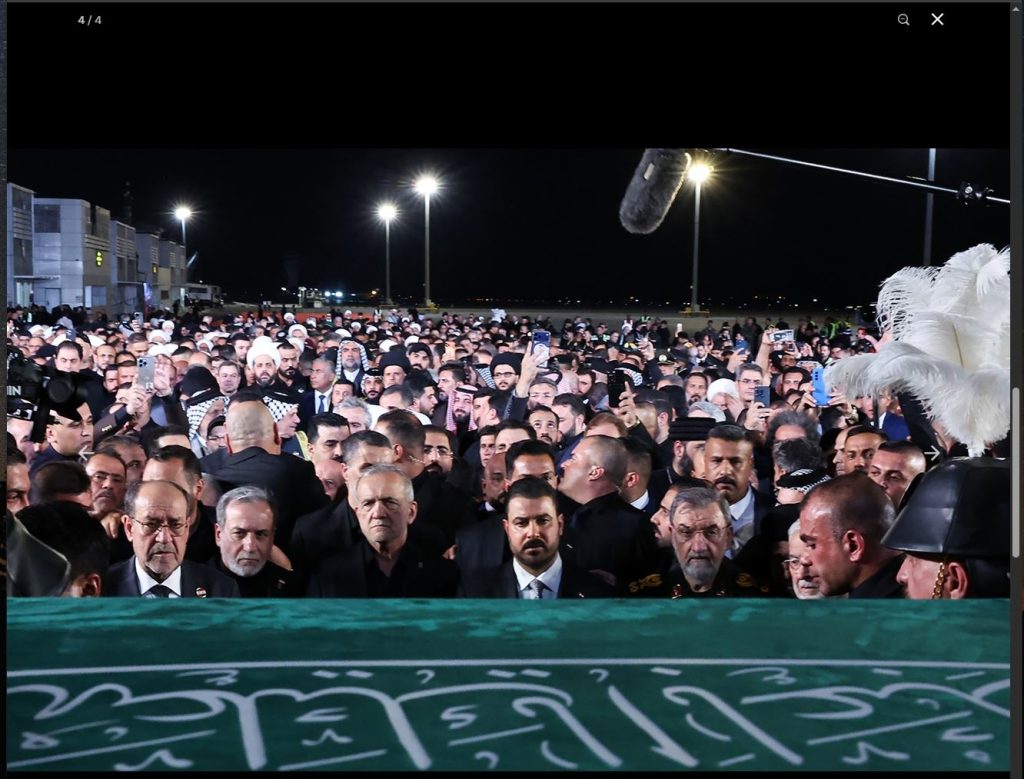
A country does not get captured by one man. It gets captured by a division of labor — a role for the cleric who lends the operation religious cover, a role for the official who lends it state legitimacy, a role for the gunman who lends it a monopoly on force, and a role for the man who lends it the appearance of an opposition that was never allowed to become real. On July 7 and 8, 2026, every one of those roles showed up in the same two cities on the same afternoon, and between them they produced the clearest snapshot yet of who actually runs Iraq — and who Iraq merely runs for.
The occasion was the funeral of Ali Khamenei. Israel and the United States killed Iran’s supreme leader in strikes on February 28; five months and a dayslong Tehran ceremony later, his remains crossed into Iraq for a state-scale procession through Najaf and Karbala, the two cities that hold the actual theological weight of Shia Islam — a foreign leader’s body drawing more official Iraqi ceremony than most Iraqi state funerals ever get.
But before any of that, someone should say plainly what these men were gathered around. Thirty-five years is a long tenure, and Khamenei spent every one of them at the top of a chain of command whose actual output — in Iraq, in Iran, in Syria, and well beyond — was bodies, not doctrine and not diplomacy. Whole cities changed hands because of decisions made in his name. Whole generations grew up around the wars, the crackdowns, and the militias that answered to him before they answered to any Iraqi law. A funeral does not erase a record like that. It only changes who gets to stand over it and call it something else. And that, in the end, is what the men gathered in Najaf and Karbala were doing: standing over the same record and relabeling it, each in his own vocabulary — theology, diplomacy, security, opposition. “Martyr” is a word for the dead who suffered the violence, not the dead man who spent thirty-five years ordering it.
The Religious Legitimizers
Sheikh Ali al-Aqeeli did not stand at that funeral as a neutral cleric paying respects to a foreign dignitary. Al-Aqeeli speaks in Baghdad as the representative of Grand Ayatollah Ali al-Sistani — the one Iraqi religious authority whose entire claim to legitimacy rests on the “quietist” tradition holding that clerics should stay out of direct rule, in explicit contrast to Iran’s Wilayat al-Faqih, the doctrine that put a supreme leader in charge of a state in the first place. Najaf has spent decades selling that distinction as sacred, as if quietism were a matter of theology rather than convenience — a mask worn by men who insist, whenever anyone asks, that they would never dream of taking it off.
They took it off in Najaf, in public, over a loudspeaker.
None of that quietist posturing stopped al-Aqeeli from telling worshippers that Khamenei’s funeral “will be a great and massive demonstration,” and declaring, in so many words, that “Sayyid Khamenei is a symbol of Islam… a scholar of the Shiites, a leader of the Shiites, and a symbol of the Shiites” — language that, for one Friday sermon, erased the entire theological distance Najaf has spent a generation insisting was real. If quietism means anything at all, it does not mean canonizing a foreign head of state as “a symbol of Islam” from the pulpit. That is not standing above politics. That is doing politics in a turban and billing it as theology.
And it did not stop at the deputy — which is exactly the moment the mask should have gone back on, if it had ever been anything more than a mask. Sistani himself broke a silence he has kept on nearly every political question outside Iraq’s own borders for two decades, issuing a formal statement calling Khamenei’s killing a “martyrdom” and urging Iranians to “maintain their unity, to stand firm and thwart the aggressors’ sinister goals.” Martyrdom. Aggressors. Strip the robe and the title off those two words and what is left is not a man declining to comment on a neighbor’s internal affairs. It is a partisan, taking Tehran’s side in a shooting war, dressed in the vocabulary of grief so that no one has to call it what it plainly is. This is not diplomatic nuance. This is hypocrisy with a doctrinal name.
Here is the con, laid bare: quietism was never a wall between Najaf and Tehran. It is a door that Najaf keeps advertised as permanently locked and opens exactly when Iran’s regional project needs it opened — then closes again the moment the cameras leave, so that on every ordinary day Sistani can be sold to Iraqis who despise Iranian rule as their guarantee that no ayatollah will ever govern them, while on the one day it actually mattered, he and his own deputy governed their loyalties for Tehran instead. Two decades of insisting they had no politics, and the moment Tehran’s founding tyrant died, both men revealed they had exactly one. This is the specific function religious legitimizers perform in Iraq: not an open alliance, which would cost Najaf its claimed independence and its market share among Shia who want no part of Qom’s state religion, but selective, occasional endorsement delivered at exactly the moment Tehran’s regional project needs a jolt of religious authority — and delivered by men, up to and including the most independent man in Iraqi Shiism, close enough to genuine independence that the endorsement reads as credible precisely because it isn’t supposed to be for sale.
The State Officials
Prime Minister Ali al-Zaidi did not send a deputy minister to the airport. He did not send a note of condolence through the embassy, the ordinary tool sovereign states keep on hand for exactly this purpose, so that a head of government is never forced to personally underwrite what a foreign regime’s death represents. He chose instead to go himself, to stand beside Iran’s own president, and to lend the full ceremonial weight of the Iraqi state to a coffin that held, by any honest accounting, thirty-five years of the violence and corruption that have hollowed out his own country — the militias, the assassinations, the stolen billions, threads that trace back in some fashion to the man inside it. Standing on that tarmac, al-Zaidi performed the one act his office should have made impossible: forgetting, in full public view, that the man being honored was not a statesman Iraq happened to outlive but the patron of the very forces that have spent thirty-five years working against it. That performance of amnesia was not incidental. It was the clearest possible signal, delivered to every Iraqi watching, of where the prime minister’s real loyalties sit when Tehran asks something of him.
His government went further still, and did it in a way no state that still calls itself sovereign should be able to live down: al-Zaidi’s office declared the day of the procession a national holiday, suspending the business of an entire country so its citizens could fill the streets mourning a foreign supreme leader. A genuinely independent Iraq does not give its people a day off work to bury someone else’s leader — a client state does.
Consider who was standing on that tarmac. Al-Zaidi is a 41-year-old billionaire with no electoral record and no political career prior to 2026 — a businessman whose empire runs through government contracts for Iraq’s food-subsidy program and army catering, banking, construction, and energy, installed as prime minister not by any vote but by a backroom deal among Shiite party bosses after a five-month deadlock, the kind of arrangement one Baghdad resident summed up as “you vote for ‘Mohammed’ but you get ‘Ali.'” He chaired a bank barred from dollar clearing in 2024 over fraud and money-laundering concerns — one of the only consequences this system has produced for itself in years, and even that landed on the bank’s books, not on the network of patronage that let it operate that way for so long. He has been photographed, over the years, alongside senior Shia militia commanders, including Qais al-Khazali — a sanctioned leader of Asa’ib Ahl al-Haq, one of the very factions whose gunmen were running security checkpoints in Najaf that same week. This is the man Iraq’s political class chose to hand the state’s ceremonial weight to.
That is not incidental; it is the state official’s actual function. It launders Iran’s regional project through the appearance of sovereign Iraqi choice, letting Baghdad’s ceremonial authority stand in for a consent the Iraqi public was never actually asked to give. It happened only because a sitting Iraqi head of government, plucked from the same patronage economy that produced the militias and the missing customs billions, was willing to stand on that tarmac and make an open act of deference look like an unremarkable act of state. His own anti-corruption drive, launched with real fanfare weeks earlier, has already been dismissed by his own government’s former integrity officials as unable to touch what one Iraqi analyst called corruption that is “politically protected… linked directly to the nature and composition of the political system” — a system al-Zaidi did not reform his way into. He was selected by it.
The Armed Enforcers
The Popular Mobilisation Forces did not turn out to Najaf as mourners. They turned out as security — the literal infrastructure that let millions of pilgrims move through the city’s streets, deployed to “key junctions” by an umbrella command whose most powerful component factions, Kata’ib Hezbollah and Asa’ib Ahl al-Haq among them, answer to Tehran with a directness no cleric or prime minister has to pretend about.
That contradiction is not incidental; it is written into Iraqi law. A 2016 act of parliament folded the PMF into the country’s formal security architecture as an independent organization with its own corporate legal personality, constituted as a part of the Iraqi armed forces and reporting, on paper, to the prime minister as commander-in-chief — its fighters paid, like the regular army and police, out of Iraq’s general state budget, through a dedicated line administered by the PMF’s own state commission. By that paper trail, the men who ran security in Najaf that week were Iraqi state employees. In practice, the factions that actually matter inside that umbrella were built, trained, and armed by Iran’s Islamic Revolutionary Guard Corps, and it is to that chain of command that their loyalty runs first. Iraq is one of the few states in the world that funds, arms, and legally shields the enforcement wing of a foreign power’s regional project out of its own treasury.
This is the oldest and least ambiguous role in the whole arrangement, and Iraqis have already paid its price in full: the secret detention facilities, the enforced disappearances, the sniper fire that killed protesters in Baghdad’s Tahrir Square and Nasiriyah during the Tishreen uprising — a crackdown that left hundreds dead and tens of thousands wounded, by rights groups’ own count — and the assassination campaign that hunted down the activists who survived the crackdown itself, a campaign for which not one commander has ever been convicted. The armed enforcers do not manufacture legitimacy. They guarantee the floor beneath everyone else’s — the fact that whatever the clerics endorse and the officials sign, no rival Iraqi political force can contest it by force, because the only force capable of contesting it was built, armed, and sustained by the same project it would be contesting.
The Opposition That Isn’t
The fourth role is the one that should give the reading public the most pause, because it doesn’t wear a uniform or a turban — and because getting it right matters more than getting it dramatic.
Moqtada al-Sadr’s entire brand is built on one claim: that he is the major Iraqi Shia leader who is not Tehran’s man. That claim has a very specific, very bloody receipt attached to it. In 2021, Sadr’s movement ran on an explicitly anti-Iranian-influence platform and won more seats than any other bloc — including the Iran-aligned Coordination Framework parties whose patronage networks and militia ties have defined Iraqi politics since 2003. When Sadr couldn’t assemble a majority to lock those parties out of government, he didn’t compromise; he pulled all 73 of his MPs out of parliament in June 2022 rather than sit in a government he cast as an Iranian project. Two months later, when the Coordination Framework moved to install its own prime minister anyway, Sadr’s followers stormed the Green Zone and the Republican Palace itself. By the time he called them off, at least 30 people were dead and roughly 700 wounded, including well over a hundred members of the security forces — the single bloodiest intra-Shia confrontation in Iraq’s post-2003 history, fought explicitly, on Sadr’s own framing, over Iranian influence in Baghdad.
That is the man. Now hold that against what he did in July 2026: not a quiet absence from Khamenei’s funeral, which would at least have been consistent, but a public call — issued before the body even reached Najaf — urging the Arbaeen pilgrims already massed across Iraq, and “the broader Islamic Ummah,” to treat the funeral procession as a mandatory act of participation, and describing the dead Iranian supreme leader as a “martyr of guardianship (Wilayah), jihad, and resistance.”
Sit with that word: Wilayah. That is not neutral funeral language. It is the specific doctrinal term — Wilayat al-Faqih — for the exact theory of clerical rule that Sadr sent 30 of his own countrymen to their deaths in 2022 rather than be seen deferring to. Fewer than four years after ordering his movement into a lethal confrontation with Iran’s Iraqi proxies, the same man used the vocabulary of Iran’s state religion to eulogize Iran’s dead supreme leader and mobilized his own street movement to turn out for the procession. That is not the record of a genuine opposition taking a principled pass on one funeral. It is the record of a release valve doing exactly the job a release valve is built for: periodically venting real anger at Iranian influence through a dramatic, telegenic confrontation like 2022 — anger that might otherwise have flowed toward a genuinely secular, cross-sectarian alternative, the actual demand of the Tishreen protest movement Sadr’s own bloc walked away from once it stopped being useful to him — and then, once the vent has done its work, quietly resealing the relationship in Tehran’s own theological terms when Tehran’s own leader is in the ground.
Every other role in this arrangement requires visible, constant proximity to Iran. Sadr’s role requires the appearance of distance, punctuated by exactly enough spectacular rupture — a burned-out Green Zone, 30 bodies, a hunger strike — to keep the brand alive, before folding back to “martyr of Wilayah” the moment the man himself is dead and the theater has served its purpose.
Function, Not Motive
None of this requires anyone to prove what was in Ali al-Zaidi’s head on that tarmac, or what al-Aqeeli — or Sistani himself — actually believes about Wilayat al-Faqih, or whether Sadr’s statement was calculated or sincere. Motive is unknowable, and arguing over it is exactly the distraction this arrangement benefits from: a debate about what these men privately believe is a debate ordinary Iraqis can never win, because belief lives inside a man’s head and nowhere else. What can be tested is function — what effect each role produced regardless of what anyone intended — and by that test the four roles do not merely line up. They interlock, each one covering precisely the gap the other three leave open.
Strip away the vocabulary particular to each man and look only at what he actually supplied. The religious legitimizer supplied permission: theology held in reserve behind two decades of professed neutrality and spent, without hesitation, on the one weekend it actually mattered, because silence from Najaf would have been read by every Iraqi as a verdict in itself. The state official supplied sovereignty: the fiction that a foreign supreme leader’s funeral was somehow proper business for the head of an independent Iraqi government — a fiction that only a prime minister with al-Zaidi’s specific résumé, installed by backroom deal and financially entangled with the same networks, was positioned to sell as normal. The armed enforcer supplied the floor beneath both of them: the plain fact that no Iraqi faction objecting to any of this could act on that objection, because the only force capable of acting was itself built, armed, and answerable to the same project it would have had to move against. And the opposition that isn’t supplied cover: the appearance that a genuine alternative to all of this exists and simply chose, this one time, to stand aside — when what it actually did was mobilize its own street to help fill Najaf’s.
None of these four men needed to coordinate with the others, and nothing here alleges that they did. That is precisely what makes the arrangement durable instead of a conspiracy that could be exposed and dismantled: it does not require a room where everyone agrees to play their part. It only requires that the incentives facing a cleric, a prime minister, a militia commander, and a populist opponent, in a state captured this thoroughly, all point independently toward the same outcome. Pull out any one of the four roles and the seam shows immediately — a state official with no religious cover reads as a foreign proxy, a militia with no democratic front reads as an occupying force, a cleric with no state left to bless reads as a foreign agent, an opposition that never ruptures reads as a subsidiary. Iraq has not had a government, a religious establishment, or a popular movement genuinely independent of Iranian influence at any point worth naming since 2003, and Khamenei’s funeral did not create that condition. It simply put all four load-bearing roles on the same stage in the same week and let them hold up the same structure in full view: a grand ayatollah calling a dead foreign supreme leader a martyr, a prime minister the banking system itself will not touch, a militia running the checkpoints, and an opposition leader mobilizing pilgrims for the funeral of the very man his own followers died fighting four years earlier. None of them needed to conspire. The arrangement does the coordinating for them.
Sources:
Al Jazeera — religious messaging
IranWire — Sadr urges pilgrims
Asharq Al-Awsat — Sistani statement
Shafaq News — al-Zaidi named PM
The National — al-Zaidi’s controversial path
Al Jazeera — al-Zaidi anticorruption campaign
2022 Baghdad clashes — background
Library of Congress — PMF legal status
Amnesty International — Tishreen impunityMiddle East Monitor — Iraq declares public holiday
2022 Baghdad clashes — background
Library of Congress — PMF legal status