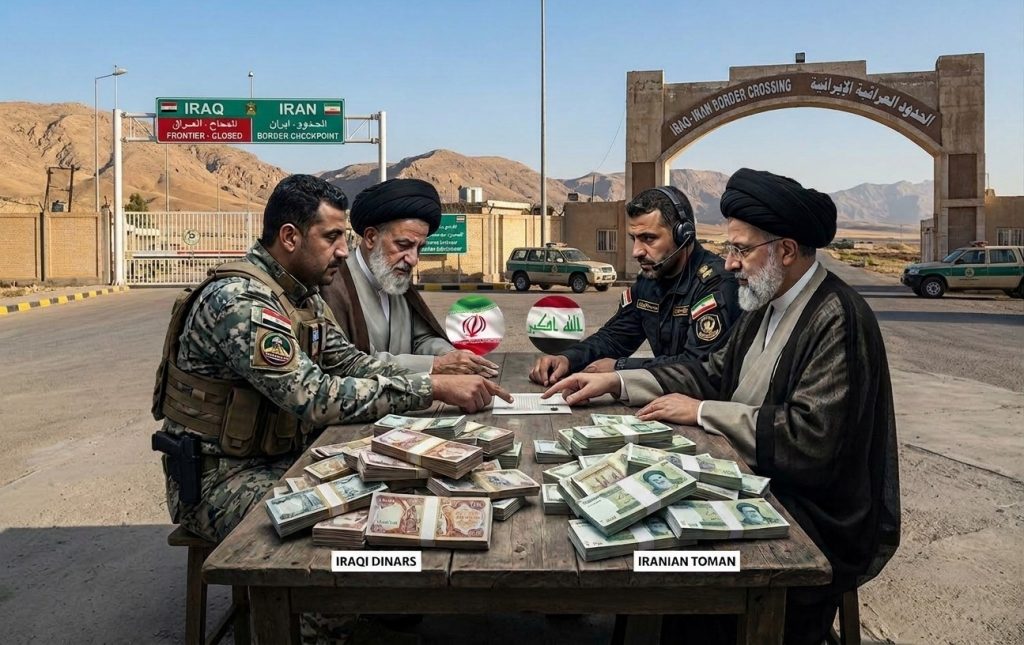
On August 21, 2026, Mohammad Bagher Ghalibaf, the speaker of Iran’s parliament, stood before a room of businessmen at Iran’s embassy in Baghdad and made his pitch: it was time, he said, for Iraq and Iran to stop settling their trade in dollars and start using their own currencies instead. He called dollar dependence “outdated” and asked for a “roadmap” toward direct dinar-toman trade. That pitch was one stop on a three-day visit built to look as much like a loyalty tour as a trade mission. Ghalibaf also met Iraq’s president, its prime minister, the head of its judiciary, and its national security adviser; sat with the Coordination Framework — the Shia parliamentary coalition that has controlled government formation since 2022 — as a bloc; and attended a mourning ceremony for Ali Khamenei in Karbala. The currency proposal did not arrive as a stand-alone technical pitch from a friendly neighbor. It arrived wrapped in exactly the kind of political theater that should make Iraqis ask what their government is actually being asked to trade away, and for whom.
It is worth being blunt about what currency Iraq was actually being asked to tie itself to. By late September 2026, Iran’s rial was trading on the open market at roughly 2.3 million to the dollar. Annual inflation, by Iran’s own state statistics agency, stood near 88 percent. Oil exports — the country’s main source of hard currency — had been throttled for months by sanctions enforcement and interdictions in the Gulf. That is not a partner offering Iraq a mutually beneficial upgrade. That is a government whose own currency is disintegrating, looking for somewhere outside its own borders to offload the damage — and Iraq’s dinar was the destination on offer.
An Imbalance Iraq Would Be Left Holding
The trade relationship Ghalibaf wants to formalize is already unbalanced, and by both governments’ own numbers, poorly measured — which should alarm Iraqis on its own, since it means no one in Baghdad can even say with confidence how exposed the country already is. Iran’s customs authority reported roughly $7.3 billion in non-oil exports to Iraq in just the first seven months of its own fiscal year, projecting more than $10 billion for the full year. Iraq’s official figures for the same stretch show barely $3.1 billion in imports from Iran — a gap of several billion dollars that regional business reporting has traced to informal and re-export channels rather than a bookkeeping error. Iraq’s own exports back to Iran run at a fraction of that, roughly $2.2 billion a year and mostly non-oil goods, against Iranian gas and electricity that once supplied close to a third of Iraq’s power grid before sanctions enforcement cut those flows sharply through 2025. Put simply: Iran already sells Iraq far more than Iraq sells Iran, collects a meaningful share of the proceeds through channels neither government can fully account for, and is now asking to formalize that imbalance in a currency that loses value by the week. There is no version of “trade in national currencies” here that isn’t, functionally, Iraq financing the difference — indefinitely, in a currency it cannot spend anywhere else, and at a moment when nobody in either government can even tell Iraqis the true size of the bill.
A Dollar System Iraq Can Least Afford to Weaken
Baghdad, for its part, is not exactly flush with dollars to spare on the experiment — which is precisely what makes entertaining this proposal so reckless. The dinar’s stability rests on a fairly narrow mechanism: Iraq’s oil revenue is deposited into an account at the Federal Reserve in New York, and the Central Bank of Iraq draws on it to run a daily hard-currency auction supplying the dollars that Iraqi importers and ordinary savers rely on. That system has been under real pressure for the past two years — not because Washington cut it off outright, but because of several forces pulling in the same direction at once: US Treasury sanctions on more than a dozen Iraqi banks over suspected dollar-smuggling to Iran, a restructuring of the auction meant to close those same smuggling routes, and Iraq’s own widening budget deficit as oil revenue collapsed, from roughly $6.8 billion in February 2026 to about $2.3 billion by that May and June, according to figures Iraqi officials themselves have cited. Iraq’s foreign reserves fell by tens of billions of dollars over the same period, and shipments of physical dollar cash into Baghdad dropped sharply. The Central Bank has publicly denied suspending those shipments and has pushed back on claims that it is responsible for the widening gap between the official and black-market exchange rates — while quietly raising gold’s share of its reserves and pursuing direct-trade arrangements with China and Turkey. Those are not the moves of an institution enthusiastic about de-dollarization. They read like a government trying to build a cushion against exactly the kind of dollar shortfall a bad year could produce — which makes it all the more damning that the same government has said nothing to rule out making that shortfall worse on Iran’s behalf.
Set against that backdrop, the timing of Ghalibaf’s request stands out as almost predatory. He is not asking a wealthy, liquid economy to diversify its currency exposure out of confidence. He is asking a government that just watched its own hard-currency reserves shrink by billions of dollars — a decline driven in real part by dollar flows leaking toward Iran in the first place — to formalize and expand exactly that leakage under the friendlier name of bilateral trade. Every dollar Iraq has spent the last two years trying to protect is a dollar this proposal would put back on the table for Tehran.
A Warm Welcome, No Public Defense
Iraq’s own prime minister, Ali al-Zaidi, met Ghalibaf and publicly praised the “historic ties” between the two countries and Iran’s support during the war against the Islamic State. Whatever the merits of that history, it is a remarkable thing to say while your own central bank is bleeding the hard-currency reserves that keep ordinary Iraqis’ savings worth something, in part because of dollar flows leaking toward the country you are thanking. Iraq’s parliament speaker, meeting Ghalibaf separately, reportedly used the occasion to ask Iran for preferential treatment on crude-oil exports through the Strait of Hormuz — a request about Iraqi oil, not a defense of the Iraqi dinar. In the weeks since, no Iraqi official has gone on record either endorsing or rejecting the currency proposal itself. That silence, coming after a visit staged with this much ceremony and against reserve numbers this alarming, is not neutrality. A government that had genuine reservations about tying its currency more closely to a collapsing one had every opportunity, across a three-day state visit with the press watching, to say so. It did not — and every week that passes without a denial is a week Iraqis are left to wonder whether the decision has already been made for them.
Who Actually Profits From the Informal Border
The reason that silence matters is that the parties running Iraq’s government are not disinterested referees weighing Iraq’s reserve position against Iran’s. The Coordination Framework is built from the political wings of Iraq’s largest Shia militias: the Dawa Party’s State of Law bloc around Nouri al-Maliki, the Fatah Alliance built on Hadi al-Amiri’s Badr Organization, and Asa’ib Ahl al-Haq’s political arm under Qais al-Khazali. Research from the Carnegie Endowment for International Peace has documented that armed factions from this same political family — Kata’ib Hezbollah, Asa’ib Ahl al-Haq, Harakat Hezbollah al-Nujaba, Tha’rallah, and Badr itself — collectively hold sway over Iraq’s land crossings with Iran, where goods have moved for years without paying the duties a formal, dollar-cleared trade relationship would require. That is the actual constituency for a toman-based trade arrangement: not the Iraqi treasury, which would absorb the currency risk, and not Iraqi households, who hold their savings in dinars, but the networks already profiting from an unregulated flow of goods and cash across that border. Formalizing the arrangement would not create this trade. It would give a legal cover story to a system that already exists, while removing the one recurring source of friction — dollar-clearing oversight — that has occasionally exposed it to sanctions enforcement.
That exposure has been real, and it has a name. In January 2024, the US Treasury designated Iraq’s Al-Huda Bank a primary money-laundering concern and sanctioned its chairman, Hamad al-Moussawi, after finding the bank had been “controlled and operated by the IRGC and the IRGC-Quds Force” since it was founded — with al-Moussawi told directly by the Quds Force to set it up. Treasury said the bank used forged documents to move at least $6 billion out of Iraq, exploiting its access to dollars from Iraq’s own currency auction to fund the Quds Force and Iran-aligned Iraqi militias, Kata’ib Hezbollah by name.
Al-Huda was never an isolated case, and the scale of the problem is worth stating in plain numbers. In July 2023, US regulators barred 14 Iraqi banks outright from dollar transactions, citing evidence of money laundering and fraud that Washington said was benefiting Iran. In February 2024, Iraq’s own central bank barred eight more — Al-Huda among them, alongside Ashur International Bank for Investment, the Investment Bank of Iraq, Union Bank of Iraq, Kurdistan International Islamic Bank for Investment and Development, Al-Janoob Islamic Bank for Investment and Finance, Arabia Islamic Bank, and Hammurabi Commercial Bank. By February 2026, the Central Bank of Iraq’s own published list had grown to 28 banks restricted from its dollar-auction window, plus four institutions blacklisted outright — including, by name, two Iranian banks, Bank Melli Iran and Parsian Bank. Add it up against the 81 banks and financial institutions Iraq’s central bank counted in its own sector as of mid-2026, and close to two in every five of Iraq’s banks have now been flagged, restricted, or cut off entirely over dollar flows connected to Iran. That is not a fringe problem inside Iraq’s financial system. It is close to becoming the system’s defining feature — and it is the same financial system a formal, dinar-toman trade channel would have to run through.
Separately, the Washington Institute for Near East Policy has publicly urged sanctions specifically against Maliki and Amiri over their role in stalling the disarmament of Iran-aligned militias, and other Washington-based analysts have described Washington’s alarm as the same pro-Tehran bloc dominated the process of selecting Iraq’s last prime minister. None of this is ancient history. It is the same set of parties, the same financial habits, and the same relationship to Tehran that were on display when Ghalibaf’s plane landed in August — and it is a preview of exactly what a formal, less-scrutinized toman channel would make easier to repeat, at a larger scale, with Iraq’s own currency system providing the cover.
A Door Already Being Opened
The political cover for a shift like this does not need to arrive as a single dramatic vote. In early September 2026, Iraq’s central bank governor announced that Iraqi banks — as part of a broader reform effort with the consulting firm Oliver Wyman — would begin transacting in non-dollar currencies, framed publicly as evidence the banking sector had “overcome” the sanctions era rather than as any concession to Iran specifically. Taken on its own, that is a defensible modernization step. Taken alongside a visiting Iranian parliament speaker’s request for dinar-toman settlement, an unexplained government silence on that request, and a governing coalition whose armed wings already move untaxed goods across the Iranian border, it looks like something else: an environment being quietly prepared in which an Iran-specific currency channel could be embedded inside a general de-dollarization trend, with no single moment that required a public debate or a recorded vote — and no single official who would ever have to answer for it.
What Iraqis Are Actually Being Asked to Carry
Strip away the diplomatic language and the arrangement being floated asks ordinary Iraqis to absorb a cost that the parties negotiating it would not have to pay themselves. A citizen’s salary or savings account, still priced in dinars backed by Iraq’s dollar reserves, is one of the few things in the post-2003 Iraqi economy that has held its value — and it is being offered up, quietly, as collateral for a partner whose own currency has lost the overwhelming majority of its worth and is still falling at nearly 90 percent inflation a year. The political networks that stand to gain from a formal toman channel are not the ones holding dinar savings accounts exposed to that kind of collapse; they are the ones already running the trucks and the cash across the border, for whom a weaker dinar and a legalized toman channel are simply a wider margin. Every dollar Iraq’s central bank has scrambled over the past two years to keep in reserve, every gap between the official and black-market exchange rate that ordinary Iraqis already feel at the market, every billion-dollar discrepancy no one in either government can explain — all of it points toward the same conclusion: this is not a trade proposal Iraq can afford to entertain, and the fact that its own governing parties have not said so, given who they are and what they have already been caught doing with Iraq’s financial system, gives Iraqis every reason to fear the answer has already been decided, and it was not decided in their favor.
Sources:
The National — Iran’s Parliament Speaker Arrives in Iraq for Three-Day Visit
Asharq Al-Awsat — Ghalibaf Urges Baghdad to Break Economic Dependence on Washington
Shafaq News — Ghalibaf Urges Iraq-Iran Trade Shift From Dollar
Arab News — Ghalibaf’s Iraq Visit and Iran-Aligned Factions
Trading Economics — Iran Inflation Rate
Alanchand — USD/IRR Exchange Rate
Iraqi News — Iraq Imports $7.3 Billion Worth of Non-Oil Goods From Iran in 7 Months
The Media Line — Iraq’s Shadow Trade Gives Iran a Lifeline
Clingendael Institute — Misery Loves Company: Iraq and Iran’s Electricity and Gas Dependencies
OCCRP — Iraq’s Dollar Auction: The Monster Funneling Billions to Fraudsters and Militants Through the US Federal Reserve
Rudaw — Analysis: Iraq’s Dollar Reserves Under Pressure
Kurdistan24 — Central Bank Denies Dollar-Shipment Suspension
Rudaw — Central Bank Denies Responsibility for Exchange-Rate Gap
Carnegie Endowment for International Peace — Border Crossings: The Unholy Alliance Between Iran and Iraqi Militias
Iraqi News — Washington Institute Advises Sanctions on Maliki and Amiri Over Disarmament Obstruction
Kurdistan24 — Coordination Framework Deadlocked Amid US Sanctions Pressure
U.S. Treasury — Treasury Sanctions Al-Huda Bank Chairman for Supporting IRGC-Quds Force
Iraq Business News — US Sanctions Iraqi Bank; $6bn Fraudulently Transferred
The National — US Bars 14 Iraqi Banks From Dollar Transactions
Investing.com / Reuters — Iraq Bans 8 Local Banks From US Dollar Transactions
Iraq Business News — Iraqi Banks Restricted From US Dollar Transactions: Full List
Yahoo Finance / Reuters — Iraq’s Central Bank Revokes Iran’s Bank Melli Operating Licence
Shafaq News — Iraq’s Banking Sector Grows to 81 Institutions
Shafaq News — Explainer: Iraq’s Coordination Framework and Its Rise to Power
The Price of Loyalty: Iraq’s Pro-Iran Parties and a Currency Deal Only Ordinary Iraqis Would Pay For