March 12, 2024
On 30 January 2024, lawyers for the Kurdistan Victims Fund filed an expansive case against Masoud, Masrour, and Waysi Barzani and many of their key aides. The case alleges a number of crimes ranging from corruption and counterfeiting to torture and murder, and documents each charge extensively. For example, it not only alleges that Masrour and Waysi were directly responsible for the murder of a U.S. intelligence officer, but it also includes photographs of his body after Masrour and Waysi’s henchmen beat him to death.
I am not party to the case but became aware of it approximately 18 months ago as researchers began witness interviews. Rather than lash out at the plaintiffs, Masrour should question his U.S. representatives at the time: Bayan Sami Abdul Rahman and Treefa Aziz. That neither was aware of the investigation even as investigators conducted hundreds of interviews reflects the bubble in which they existed. The Kurdish leadership spends millions of dollars in Washington but, because their representatives limit themselves to the Kurdistan Democratic Party rather than broader Kurdish interests, they operated blind. Masrour even appeared unaware that some close associates noticeably absent from the list of defendants appear to have spoken to investigators and negotiated immunity for themselves at his expense.
As a courtesy, lawyers for the Kurdistan Victims Fund presented Treefa Aziz with the case and offered three weeks to negotiate. She dutifully flew to Erbil, but Masrour declined to both negotiate and forewarn other defendants about the ruinous legal peril in which they now find themselves.
Those close to the case say Masrour believes he can get the case dismissed, much as he did an earlier and unrelated case filed in November 2022 by Shnyar Anwar Hassan. While that case accused Masrour personally of libel and slander, Masrour is foolish to believe it sets a precedent. In both law and venue, the Shnyar case is unrelated; she is not involved in the current case.
There are four reasons why Barzanis are foolish to believe the U.S. District Court for the District of Columbia will dismiss the case on sovereign immunity grounds.
First, while Masrour may say he has sovereign immunity, his U.S. permanent residency undermines this. He cannot both claim to be a U.S. resident, as he has for years, and say he is a foreign official immune under U.S. law. Rather, his permanent residency raises tax and transparency questions that Masrour will no longer be able to evade.
Second, while Masoud is not a U.S. citizen, this does not immunize him. Within the U.S. Judiciary, there are three levels of federal courts: the U.S. District Court where the Barzani suit now rests, U.S. Circuit Court of Appeals, and the U.S. Supreme Court. Unfortunately for Masoud, Supreme Court precedent goes against him. In 2010, the Supreme Court ruled against former Somalia Prime Minister Muhammad Ali Samatar in a case against him leveled by Somali torture victims. The Court found that Foreign Sovereign Immunities Act did not shield Samatar from crimes committed under the Torture Victim Protection Act, the same law Masoud violated.
Third, much of the Kurdistan Victims Fund lawsuit also involves financial crimes, corruption, and cheating foreign businessmen. Unfortunately for the Barzanis, the Foreign Sovereign Immunities Act does not immunize them from accountability under U.S. law for corruption and fraud either. Representatives from two other governments—Argentina and Turkey—have previously made the arguments Masrour now does. Both lost. In 1992, the Supreme Court decided unanimously against Argentina in Republic of Argentina v. Weltover, Inc, a suit in which the Argentine government sought immunity in U.S. court after defaulting on commercial obligations. Just three years ago, Turkey lost a similar immunity case based on Türkiye Halk Bankasi’s criminal activities.
Fourth, case law surrounding the Alien Torts Case Act of 1789 are not in the Barzanis’ favor. That law grants U.S. courts jurisdiction over any civil action where a non-U.S. citizen or resident sues for redress of a crime “committed in violation of the law of nations or of a treaty of the United States.” The numbers of laws and treaties the Barzanis’ crimes contravene is long, hence the case being over 300 pages and many of their victims are Iraqis.
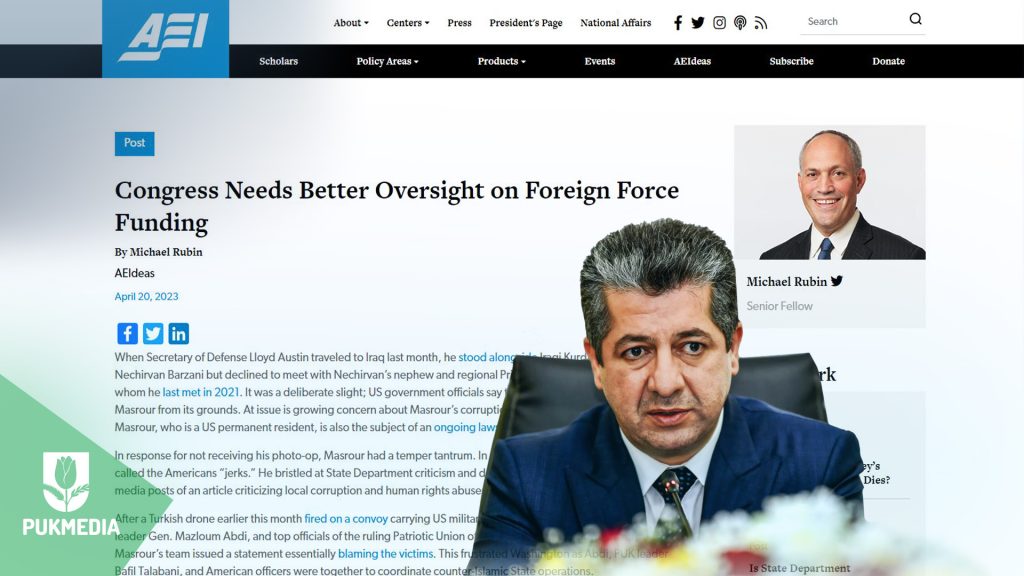
On February 23, 2024, Masrour Barzani flew by private jet to Dulles Airport in Washington, DC. His main purpose was to meet with his lawyers.
While his handlers went into overdrive to suggest his trip was diplomatic and he received a warm welcome, even the videos he released suggest otherwise. There were no senior American officials to greet him at the airport, nor was there any official convoy to drive him into town. He met briefly with Blinken as a courtesy only, hence the lack of substantive detail. To Masrour’s disappointment, Blinken has no authority to intervene in a case in which the State Department is not party. Washington is not Baghdad, and it is not Erbil.
A meeting the following day with think tank analysts started 20 minutes late as Masrour sought to avoid U.S. Marshalls seeking to deliver court papers to him. Rather than have a think tank or university host him, Masrour sought to have a law office so he could better limit access to hand-picked loyalists.
Meanwhile, official Washington understands that even if the Barzanis manage to sidetrack parts of the lawsuit, they cannot erase its documentation of their crimes. Already, hearings are brewing in Congress. Even traditional Barzani friends now question whether the ruling family represent more trouble than it is worth.
Source: https://www.aei.org/op-eds/barzanis-misplaced-hope-for-dismissal-of-kurdistan-victims-fund-case/